Wednesday, 10 September 2008

LHC: Large Hadron Collider: What could we discover...?

I am eagerly waiting for the first results to come out of the LHC, and the next, and then the ones after that...

The possibilities for advancing theoretical physics through experimentation are remarkably rare, so an event of this magnitude should be followed with interest. Whatever the results, physics is about to undergo a huge leap forward.

As long as we are still around to see it... {Joke}

However, I have a question regarding the nature of Time&Space that seems to have been ignored, as it is most difficult to find an answer. Either that or I am being an idiot... :->

What Happens to Time when there is no matter?

We understand that the presence of Energy/Matter causes gravity and the curvature of SpaceTime. In fact with enough energy/matter density we get a gravity well of such density that it is effectively infinite, i.e.: a black hole.

It should also be noted that gravity and time are linked. As gravity becomes bigger, time dilates and each period of time lengthens.

Until we reach the theoretical point: that a person (who survived) falling into the event horizon of a black hole would experience such extreme time dilation that they would be able to watch the end of the universe.

This seems to be the normal point of interest, and everyone stops there.

However, my question relates to the opposite.

The opposite of everything?

Before the Big Bang, when there was no matter or energy, there was nothing to curve SpaceTime.

What happens to time in this situation?
What is the shape of the curve?

As far as I can see there are two probably answers.

1. It is a simple curve, and time tends towards a fixed point
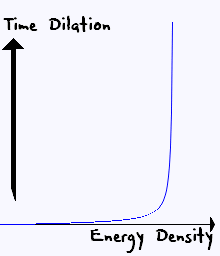
2. It is a TAN like curve, where time tends towards infinite values.


For some reason I rather like the 2nd answer, but I have been unable to find anything that would suggest this is the case.

It is an interesting theory, as given my assumption that Curve2 is correct: then all time before the Big Bang, i.e.: before the existence of energy/matter, would be contracted into an infinitely short period. At least from a theoretical observers point of view.

In effect the opposite of a a back hole, the opposite of a gravitational singularity with time dilation.

So my question is:
In the TOTAL absence of energy/matter, does time becomes a singularity.

Request for comment

I have been looking for an answer to this question for a few years. Can you help? Do you know anyone who has already considered or answered this?

Please let me know.

Monday, 8 September 2008

Speed Testing Chrome for List Processing

What are we testing?

As Rich Internet Application development progresses, more and more developers are moving towards the functional programming capabilities of JavaScript.

First Order Functions, Closures, Macros and Lists are becoming a mainstream method of development.

When you can tell the computer how to do it, rather that listing what it needs to do, it becomes much easier to write a program and needs a lot less code.

Think recipe instead of precise instructions.

So how does Chrome compare to the other browsers when doing this?

What did we test?

I used JSTR to create a re-usable test of basic Functional programming.

The test creates a list(array) from a DOM collection, runs a filter on the list to identify the required elements, then performs an action on those elements remaining.

Follow this LINK to run the test for yourself.
Paste the link into another browser to test it on different systems.

The test is pretty basic, but it provide a nice demonstration of the capabilites of Chrome.

So how did they do?

Testing 1000 loops on a windows XP machine with 2Gb ram:
Testing used 10 repetitions for averaging.


Conclusions

It looks like the more modern browsers (FF3, Chrome, Safari) are now concentrating a great deal on Javascript performance. A very good piece of news for anyone developing Rich Internet Applications.

I must admit I was surprised by the performance of Safari on WindowsXP but it is nice to get surprises like this.

I had expected Chrome to out perform everything else and was a little disappointed to see otherwise. However, it is definetely a top notch Javascript system and I look forward to watching it develop.

This test does raise the issue that older versions of any browser will have significant differences in run-time speed for your application.

It looks like we will soon be back to the days of specifying a minumim compatible browser version, and the list will be quite short.

Request for Comments

If you have a different operating system or browser... can you please let me know how it performs in this test?
  1. Use the link above to launch JSTR, pre-loaded with the test..
  2. Clear the Console
  3. Press RUN

If you can leave a comment with the output, I will add it to the data collected.

Tuesday, 2 September 2008

How fast are chrome plugins?

It just occured to me, that, as the V8 javascript engine compiles JavaScript to native code...

...any plugin written in JavaScript should run at native speeds...

Does anyone have any more information on this?